

Deploying Agentic AI Systems in real-world environments can be fraught with operational friction. Ensuring that AI agents can autonomously interact with external tools and APIs is crucial for achieving reliable and scalable performance. This guide delves into the core concepts, implementation strategies, and real-world applications of production tool-calling frameworks, helping you master these frameworks and enhance your AI workflows.
Core Concept & Technical Framework
Key Architectural Components
Production tool-calling frameworks are essential for deploying Agentic AI Systems effectively. These frameworks enable AI agents to interact with external tools and APIs autonomously, ensuring reliable and scalable performance. Key architectural components include:
- Retry Logic: Ensures that failed tool calls are retried automatically, improving the reliability of AI workflows. This component is crucial for handling transient errors and ensuring that tasks are completed successfully.
- Timeout Handling: Manages the duration for which a tool call is allowed to execute. This prevents infinite loops and ensures that the system remains responsive, even if a tool call fails to complete within the expected timeframe.
- Execution Boundaries: Defines clear boundaries for tool execution, ensuring that AI agents operate within predefined parameters. This includes setting limits on the number of retries, timeout durations, and other execution constraints.
- Orchestration Mechanisms: Coordinates the interaction between AI agents and external tools, ensuring that tool calls are executed in the correct sequence and that dependencies are handled appropriately. This component is essential for managing complex workflows and ensuring deterministic execution patterns.
To understand how these components interact, consider the following diagram:
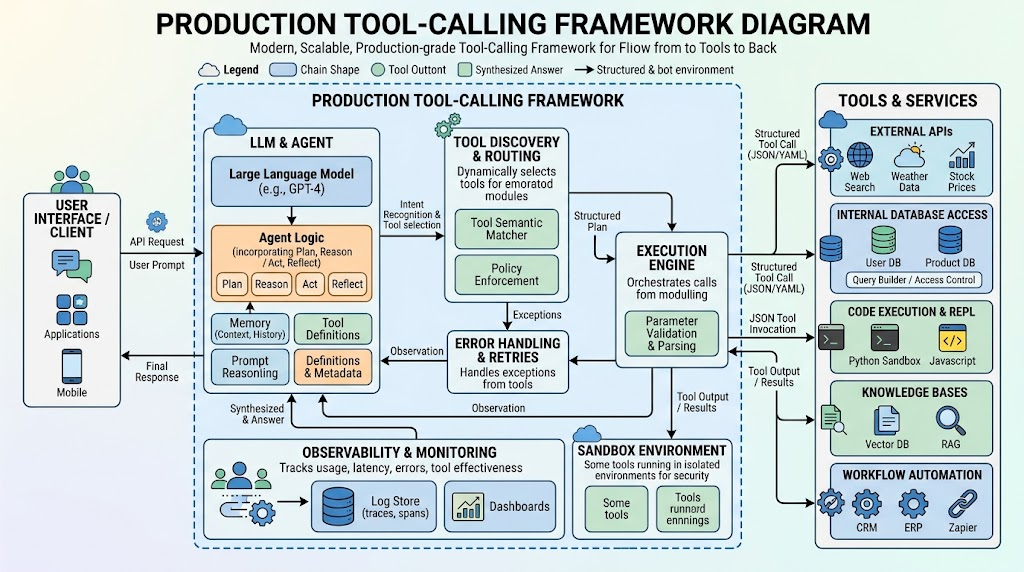
In this diagram, the orchestration mechanisms act as the central hub, coordinating the activities of multiple AI agents. The retry logic and timeout handling ensure that tool calls are executed reliably and efficiently, while the execution boundaries define the parameters within which the agents operate. This structured approach enables seamless interaction with external tools and APIs, ensuring reliable and scalable performance.
Comparison vs Legacy Methods
Traditional AI methods often rely on centralized, monolithic architectures that lack the flexibility and scalability required for real-world applications. In contrast, Agentic AI Systems are designed to operate in a decentralized manner, with agents working independently or in collaboration to achieve specific goals. This decentralized approach offers several advantages, including:
- Scalability: Agentic AI Systems can scale horizontally, adding more agents to handle increased workloads without compromising performance.
- Flexibility: Autonomous AI agents can adapt to changing environments and requirements, making them more versatile than traditional AI systems.
- Resilience: Decentralized architectures are more resilient to failures, as the system can continue to operate even if some agents go offline.
To illustrate the differences between traditional AI and Agentic AI, consider the following comparison table:
| Aspect | Traditional AI | Agentic AI |
|---|---|---|
| Architecture | Centralized, Monolithic | Decentralized, Modular |
| Scalability | Vertical Scaling | Horizontal Scaling |
| Flexibility | Limited | High |
| Resilience | Low | High |
These differences highlight the advantages of Agentic AI Systems over traditional AI, making them a more suitable choice for enterprises seeking to implement autonomous operations. For a deeper dive into the technical aspects of Agentic AI, refer to our technical guide on multi-agent workflows.
Enterprise Implementation & Execution
Technical Prerequisites & Stack Integration
Implementing production tool-calling frameworks in an enterprise environment requires careful planning and execution. Key technical prerequisites include:
- Compute Requirements: Ensure that your infrastructure has sufficient computing power to handle the demands of multiple AI agents. This may involve investing in high-performance servers, GPUs, or cloud-based computing resources.
- Orchestration Tools: Choose orchestration tools that can manage the deployment, scaling, and monitoring of AI agents effectively. Popular options include Kubernetes, Docker Swarm, and Apache Mesos.
- Data Integration: Implement data integration solutions that can feed the right information to AI agents in real-time. This may involve using data pipelines, ETL tools, or real-time data processing frameworks.
- Security Measures: Deploy robust security measures to protect your infrastructure and data from potential threats. This includes implementing firewalls, encryption, and access controls.
Integrating these components into your existing tech stack requires a well-structured approach. Start by assessing your current infrastructure and identifying areas that need improvement. Then, develop a roadmap for integrating the necessary components, ensuring that they work seamlessly with your existing systems. For a comprehensive guide on integrating Agentic AI into your enterprise, check out our Agentic AI Systems guide.
Security, Governance & Compliance Rules
Security, governance, and compliance are critical considerations when implementing production tool-calling frameworks. Enterprises must ensure that their infrastructure and data are protected from unauthorized access and potential threats. Key security measures include:
- Data Protection: Implement encryption, access controls, and other security measures to protect sensitive data from unauthorized access.
- Compliance Frameworks: Adhere to industry-specific compliance frameworks, such as GDPR, HIPAA, or PCI-DSS, to ensure that your AI operations comply with regulatory requirements.
- Governance Models: Establish governance models that define roles, responsibilities, and policies for managing AI operations. This includes implementing audit trails, logging, and monitoring to ensure compliance and accountability.
For enterprises looking to implement production tool-calling frameworks, it’s essential to conduct a thorough security audit to identify potential vulnerabilities and ensure compliance with relevant regulations. Our AI Audit Tools can help you assess your infrastructure’s security posture and identify areas for improvement.
Business Impact, ROI & Case Use
Measurable ROI Benchmarks & Efficiency Gains
Implementing production tool-calling frameworks can deliver significant business impact and ROI. Key benefits include:
- Cost Savings: Autonomous AI agents can automate repetitive tasks, reducing the need for manual intervention and lowering operational costs.
- Operational Efficiency: AI agents can operate 24/7, ensuring continuous operations and improving overall efficiency.
- Performance Metrics: AI agents can provide real-time insights and analytics, enabling enterprises to make data-driven decisions and optimize performance.
To quantify the ROI of production tool-calling frameworks, consider the following metrics:
- Cost Savings: Calculate the reduction in operational costs due to automation.
- Operational Efficiency: Measure the improvement in operational efficiency, such as reduced response times or increased throughput.
- Performance Metrics: Track key performance indicators (KPIs) such as accuracy, precision, and recall to assess the effectiveness of AI agents.
For example, a manufacturing company implementing autonomous AI agents for predictive maintenance could see a 30% reduction in downtime, leading to significant cost savings and improved operational efficiency. Similarly, a financial services firm using AI agents for fraud detection could achieve a 20% increase in detection accuracy, resulting in substantial cost savings and enhanced security.
Real-World Industry Applications
Production tool-calling frameworks have a wide range of applications across various industries. Some notable examples include:
- Healthcare: Autonomous AI agents can assist in diagnosing diseases, predicting patient outcomes, and optimizing treatment plans. For instance, AI agents can analyze medical images to detect anomalies, providing early warnings of potential health issues.
- Finance: In the finance sector, AI agents can be used for fraud detection, risk assessment, and portfolio management. They can analyze transaction data in real-time to identify fraudulent activities, helping financial institutions mitigate risks and protect their assets.
- Manufacturing: In manufacturing, AI agents can optimize production processes, predict equipment failures, and enhance supply chain management. For example, AI agents can monitor machine performance in real-time, detecting anomalies and predicting maintenance needs before failures occur.
These examples illustrate the transformative potential of production tool-calling frameworks across various industries. By leveraging autonomous AI agents, enterprises can achieve significant operational efficiencies, cost savings, and performance improvements. For more insights into the practical applications of Agentic AI, explore our guide on autonomous AI agents.
People-Also-Ask & FAQ Strategy
What are the key components of a production tool-calling framework?
The key components of a production tool-calling framework include retry logic, timeout handling, execution boundaries, and robust orchestration mechanisms. These components work together to ensure that AI agents can interact with external tools and APIs autonomously, providing reliable and scalable performance.
How do production tool-calling frameworks differ from traditional AI methods?
Unlike traditional AI methods, production tool-calling frameworks enable autonomous interaction with external tools and APIs. This provides scalability and reliability in real-world applications, allowing enterprises to handle increased workloads and adapt to changing environments more effectively.
What are the technical prerequisites for implementing production tool-calling frameworks?
Technical prerequisites for implementing production tool-calling frameworks include a robust infrastructure, reliable APIs, and a well-integrated tech stack. This ensures that AI agents can interact with external tools and APIs autonomously, providing reliable and scalable performance.
What security measures are necessary for deploying Agentic AI Systems in production?
Security measures for deploying Agentic AI Systems in production include data encryption, access controls, and compliance with industry regulations. These measures protect the infrastructure and data from unauthorized access and potential threats, ensuring the integrity and confidentiality of operations.
How can production tool-calling frameworks enhance business efficiency?
Production tool-calling frameworks automate complex workflows, reduce manual intervention, and improve overall operational efficiency. By enabling AI agents to interact with external tools and APIs autonomously, enterprises can achieve significant cost savings, operational improvements, and performance gains.
Conclusion
Mastering production tool-calling frameworks is crucial for deploying Agentic AI Systems effectively. By understanding the core concepts, implementation strategies, and real-world applications, you can enhance your AI workflows and achieve significant business impact. The benefits are clear: cost savings, operational efficiency, and tangible business outcomes.
To start your journey with production tool-calling frameworks, take advantage of Pixels Studio’s free audit or schedule a 30-minute strategy consultation to assess your infrastructure and identify areas for improvement. With the right frameworks in place, you can harness the power of autonomous AI agents to drive business growth and innovation.


